The 1983 No S Proof dime has sold for $10,560 at auction — yet most 1983 dimes in your pocket change are worth exactly ten cents. The difference comes down to mint mark, condition, and one elusive variety. Here's everything you need to know.
Check My 1983 Dime Value →The 1983 No S Proof is the most iconic variety of the year. It's a genuine proof coin struck with mirror-like fields — but missing the "S" mint mark that should identify it as a San Francisco issue. Use this checker to see if your coin might qualify.
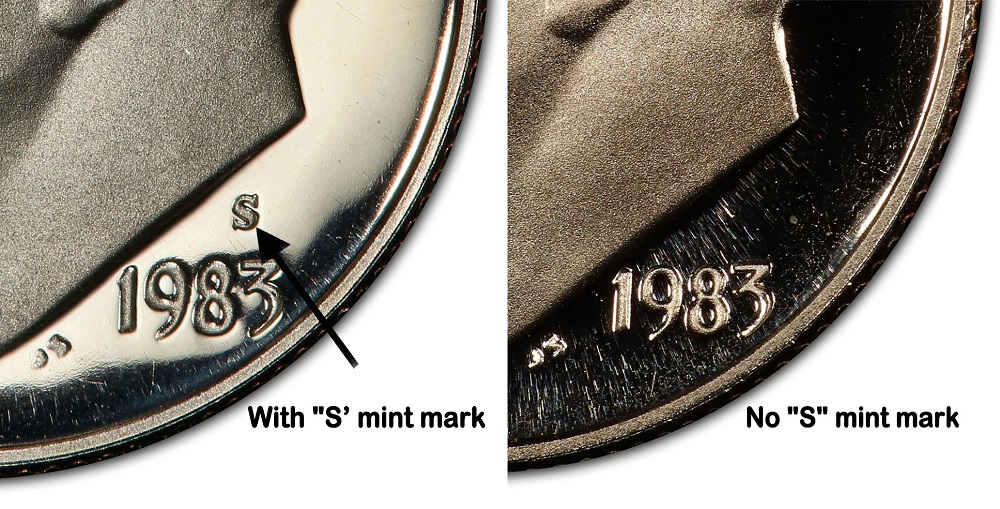
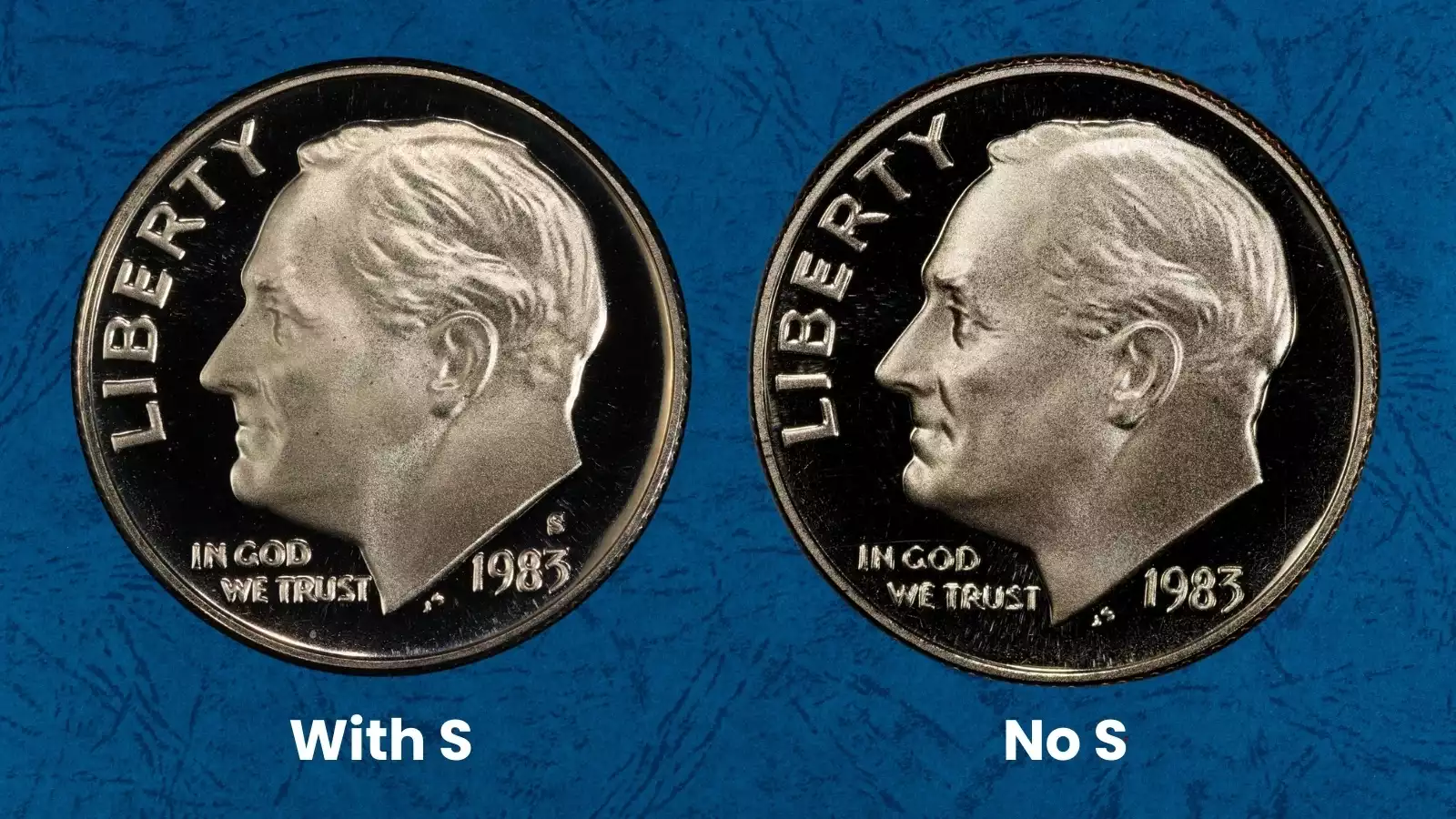
Has a small "S" mint mark on the obverse, to the right of Roosevelt's neck above the date. Mirror-like fields with frosted devices. Worth $6–$15 in PR-69 DCAM. Found in standard proof sets sold by the U.S. Mint.
Identical proof surfaces — mirror fields, frosted devices — but the "S" mint mark is completely absent. Not weakly struck, not worn away, just gone. Confirmed examples have sold from $535 (PR-67) to $10,560 (PR-70 DCAM). PCGS/NGC authentication is mandatory.
Check all four boxes that apply to your coin:
Not sure what you have? Describe your coin in plain language and our keyword-matching analyzer will identify likely varieties and give you a targeted value range.
Already know your mint mark and condition? Skip straight to the value calculator for an instant estimate.
Go to Calculator →Follow the three steps to estimate your coin's value. Select one option per step, then hit Calculate.
If you're still figuring out your coin's mint mark or condition, there's a 1983 Dime Coin Value Checker online tool that lets you upload a photo of your coin for an AI-powered estimate — no numismatic knowledge required to get started.
Jump to any section using the links below.
Five documented varieties and errors can turn an ordinary 1983 Roosevelt dime into a coin worth far more than face value. The split list on the left links to each card — click any variety name to jump straight to its full description and diagnostic details.
The 1983 No S Proof is the third and final No S Roosevelt dime error in the entire series, joining the legendary 1968 and 1970 issues. It occurred when at least one proof die was prepared at the Philadelphia Mint and shipped to San Francisco without being impressed with the required "S" mint mark. Coins struck from that die are genuine, fully proof-quality pieces, displaying mirror-like fields and frosted devices — but no mint mark of any kind.
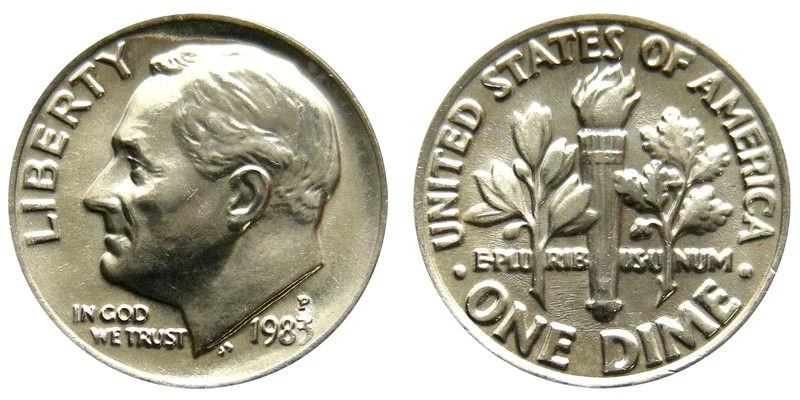
Visually, the identifying characteristic is straightforward: look at the obverse just above the date, to the right of Roosevelt's neck truncation. A standard 1983-S Proof has a clear "S" there. The No S Proof has a completely blank field in that position — not a weak strike, not a removed mark, just an unimpressed die. Under a loupe, the field should be polished and smooth where the letter would have been.
PCGS estimates several hundred examples exist across all grades, with approximately 558 pieces graded DCAM by PCGS alone as of 2025. In PR-67 DCAM, recent sales have ranged from $535 to $735; PR-68 DCAM examples sell for approximately $575–$700; and PR-70 DCAM specimens have commanded $2,760 to $10,560, with the $10,560 record set at Great Collections in November 2014. Authentication by PCGS or NGC is mandatory before any transaction — fakes exist where the "S" has been removed from a standard 1983-S Proof.
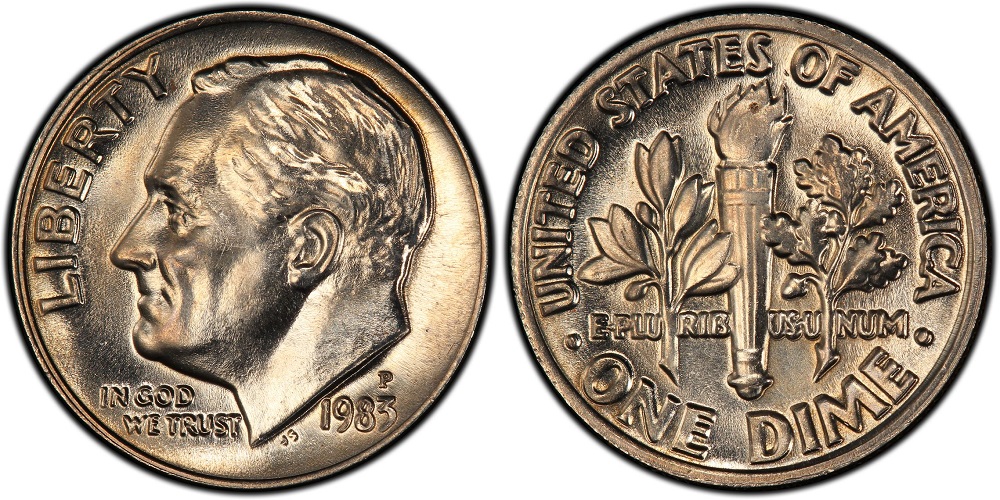
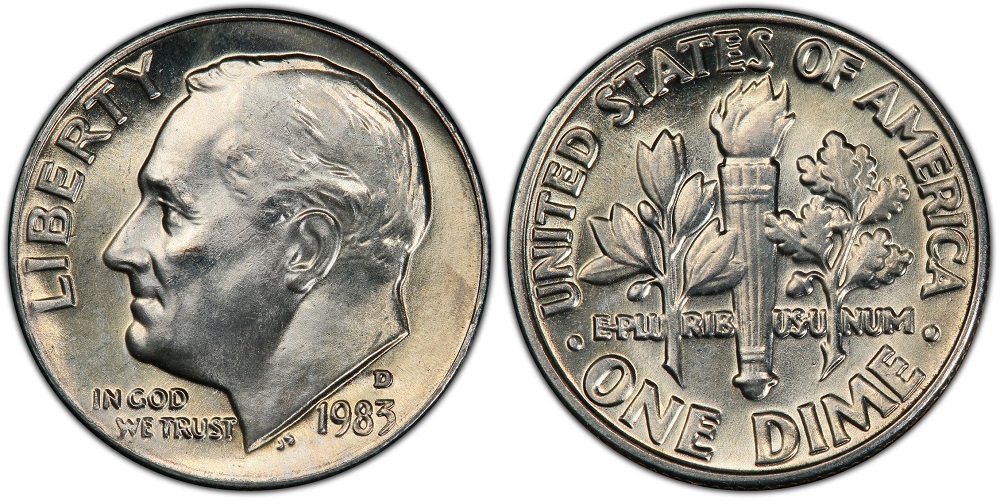
The Full Bands designation — awarded by PCGS and NGC when every horizontal band across the torch on the reverse is completely separated and sharply defined — represents an extreme condition rarity on 1983 Philadelphia dimes. By 1983, the Roosevelt dime hub had suffered years of progressive detail loss. Combined with heavily used production dies, sharply struck coins from this year are genuinely uncommon, and coins showing full torch band separation are exceptionally rare.
To earn the FB designation, all four horizontal lines across the torch bands must be completely separated, with no merging or bridging visible even at 10× magnification. On a standard 1983-P, these bands typically blur or merge due to the weakened hub relief and die wear. A coin displaying clean, uninterrupted band separation is a genuine condition rarity — CoinWeek reports that Full Torch examples represent fewer than 2% of all 1983-P dimes submitted to PCGS.
The population is strikingly thin at the top end. Heritage Auctions recorded a sale of $2,232.50 for a PCGS MS-68 FB example in December 2015. MS-67 FB specimens have sold in the range of $558 (Heritage, December 2014) to higher current values. PCGS population data shows only a handful of examples at MS-67 FB and above, making this one of the genuine condition rarities of the modern clad series.
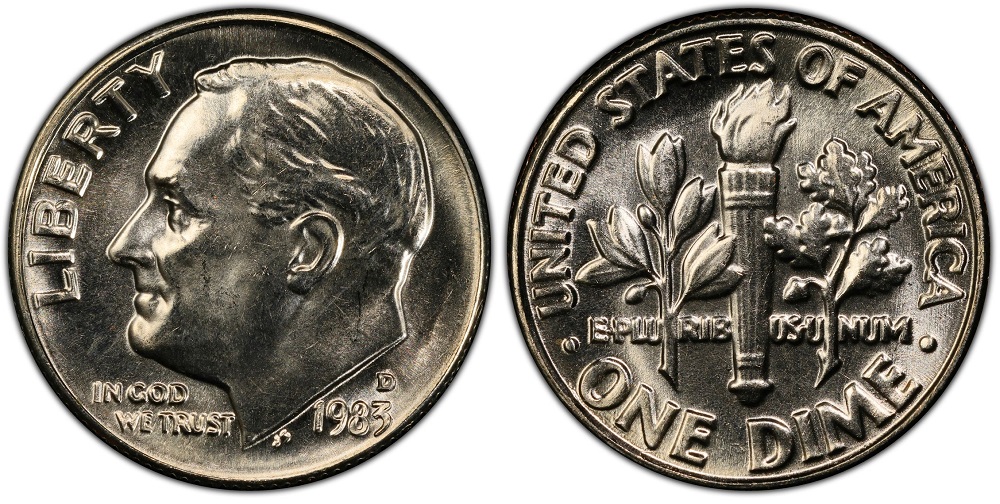
The 1983-D Full Bands variety mirrors the rarity dynamic seen on Philadelphia strikes, though the Denver version commands somewhat lower premiums due to a slightly higher certified population. Denver's 1983 production suffered from the same hub deterioration and die wear that afflicted Philadelphia, making fully separated torch bands a rare feature on coins from either mint. Only a small fraction of 1983-D dimes survive in high-grade Mint State with the FB designation.
Diagnostically, the Full Bands check on Denver coins is identical to the Philadelphia version: under 10× magnification, all four horizontal lines across the reverse torch must be cleanly separated with no merging. Denver dimes may show slightly better strike characteristics on average due to different die maintenance practices, but examples with complete torch band separation remain scarce enough to command strong premiums from dedicated Roosevelt dime specialists.
Greysheet data indicates 1983-D FB values ranging from $195 at the low end to $1,900 in the highest certified grades. PCGS populations confirm this scarcity — the five known MS-67 FB Denver specimens reported by CoinValueChecker represent the absolute ceiling of what's achievable for this variety. MS-66 FB examples with complete torch separation wholesale near $475 according to multiple sources.
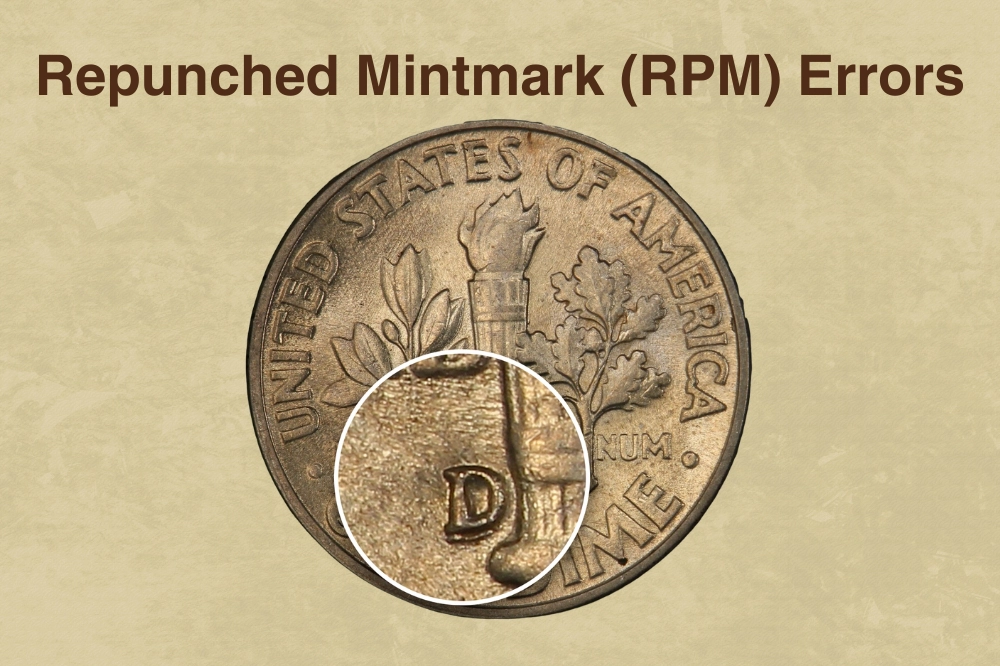
The 1983-D RPM FS-501 — also cataloged as CONECA RPM-001 and nicknamed "D/D North" — is a recognized die variety from the era when mint mark punches were applied by hand to working dies. The error occurred during die preparation when the mint mark punch was positioned against the die and struck once to create the primary "D" impression, then repositioned and struck a second time at a slightly higher position, leaving a secondary "D" outline shifted directly upward from the primary mark.
Under 10× or higher magnification, the diagnostic feature is a faint but unmistakable secondary "D" impression visible on the upper curve and upper serif of the primary "D" mint mark. The shift is directly northward, which is why the variety carries the "North" designation. Below about 5× magnification, the secondary impression may not be distinguishable from normal die polish marks, making a loupe or microscope essential for identification.
The 1983-D RPM FS-501 is collectible but not extraordinarily rare — hand-punched mint marks of this era produced numerous RPM varieties across many denominations, and the FS-501 is listed in the Fivaz-Stanton Cherrypickers' Guide as a documented, recognizable variety. Its primary appeal is to specialists who collect die varieties. Premiums are modest in worn grades but can climb meaningfully in high-grade certified examples. This practice of hand-punching mint marks ended in 1989 when the U.S. Mint began applying them directly to master hubs.
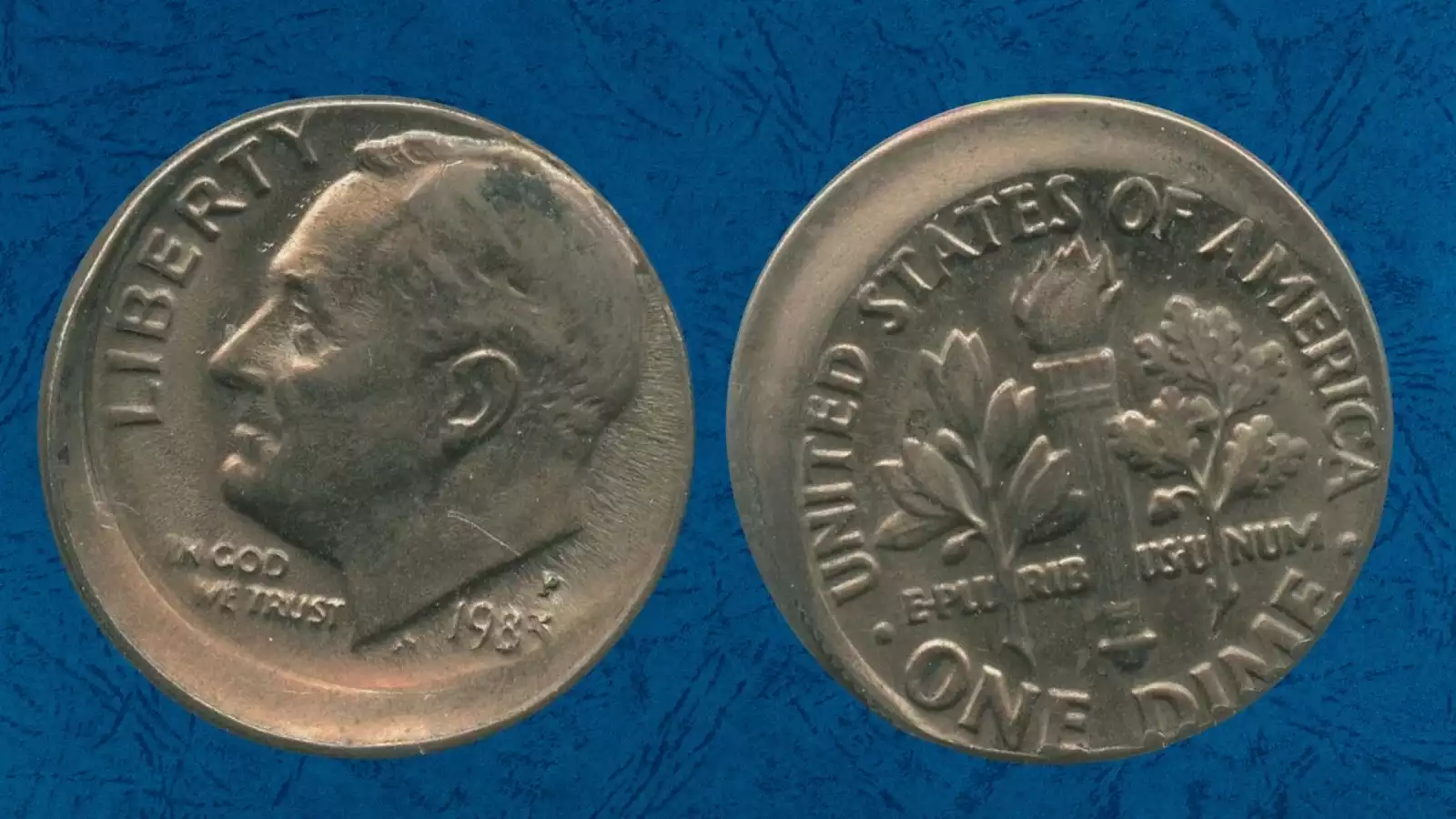
Off-center strike errors on 1983 Roosevelt dimes occur when a planchet is not correctly seated within the collar die — the restraining ring that keeps the blank centered during the striking process — before the hammer die descends. The misaligned planchet receives an off-center impression, producing a coin that displays the Roosevelt design only on a portion of its surface, while the remaining planchet area shows the original unstruck metal. The severity varies from minor 5% off-center shifts to dramatic displacements exceeding 50%.
The percentage of off-center displacement directly governs collector interest and market value. Minor shifts of 5–15% produce coins with the date barely visible and the design mostly intact, which are collectible but less dramatic. The most desirable examples — and the most valuable — are those displaced 40–60% or more while still retaining the full date and at least some of the mint mark. These dramatic pieces clearly demonstrate the error and are sought by type collectors who specialize in mint mistakes.
Both the Philadelphia and Denver mints can be the source of 1983 off-center strikes, with Denver examples appearing slightly more frequently according to documented examples. Values range from approximately $20 for minor 10–20% off-center examples in lower grades, to $100–$250 or more for dramatic 50%+ strikes where the date remains fully readable. All error coins benefit significantly from professional PCGS or NGC certification to confirm the error is genuine and document its severity percentage in the holder text.
Found one of these errors on your coin? Head back to the calculator to get a specific value estimate based on your mint mark, condition, and error type.
Calculate My Coin's Value →The table below summarizes current market values for all major 1983 Roosevelt dime varieties across every condition tier. For a complete step-by-step illustrated 1983 dime identification walkthrough with detailed grading photos, see the linked guide. Highlighted rows denote exceptional varieties. All figures are based on PCGS auction data and Greysheet CPG ranges.
| Variety | Worn (G–VF) | Circulated (EF–AU) | Uncirculated (MS-65) | Gem (MS-67+) |
|---|---|---|---|---|
| 1983-P (standard) | $0.10 | $0.10 – $1 | $5 – $8 | $75 – $480 |
| 1983-D (standard) | $0.10 | $0.10 – $1 | $5 – $8 | $75 – $525 |
| 1983-S Proof (DCAM) | — | — | $6 – $15 (PR-67) | $20 – $50 (PR-70) |
| 1983-P Full Bands (FB) ⭐ | $2 – $7 | $7 – $19 | $125 – $350 (MS-65 FB) | $1,000 – $2,233+ (MS-67+ FB) |
| 1983-D Full Bands (FB) | $0.84 – $3 | $3 – $7 | $88 – $195 (MS-65 FB) | $475 – $1,900 (MS-67 FB) |
| 1983 No S Proof DCAM 🏆 | — | — | $535 – $660 (PR-67–68) | $2,760 – $10,560 (PR-70) |
| 1983-D RPM FS-501 | $5 – $20 | $20 – $50 | $50 – $100 | $100 – $150+ |
| Off-Center Strike | $10 – $30 | $30 – $75 | $75 – $150 | $150 – $250+ |
🏆 = Signature variety (No S Proof) | ⭐ = Rarest business-strike variety (P Full Bands)
📱 CoinKnow makes it easy to snap a quick photo of your 1983 dime and get an on-the-go value estimate matched against current market data — a coin identifier and value app.
| Mint | Mint Mark | Mintage | Strike Type | Survival Notes |
|---|---|---|---|---|
| Philadelphia | P | 647,025,000 | Business strike | Extremely common; no systematic saved rolls; gem survivors scarce |
| Denver | D | 730,129,224 | Business strike | Largest 1983 production; most circulated examples worth face value |
| San Francisco | S | 3,279,126 | Proof only (DCAM) | ~2,803,652 estimated survivors (85.5% survival); sold in proof sets |
| Total | 1,380,433,350 | — | Over 1.38 billion total produced in 1983 | |
Composition: 75% copper, 25% nickel outer layers bonded to a pure copper core (copper-nickel clad copper) · Weight: 2.27 g · Diameter: 17.9 mm · Designer: John R. Sinnock · Edge: Reeded
Roosevelt's facial features, hair strands, and cheekbone show significant flatness. The torch bands on the reverse are completely merged or indistinct. Most lettering remains readable but may show rim blending in the lowest grades. Value: face value (10¢) for standard issues.
Light to moderate wear on Roosevelt's cheek and the hair above his ear — the first high points to show friction. The torch flames may show slight flatness. Original luster is largely gone from the high points but may survive in recessed areas. Value: 10¢ to $1 for most standard strikes.
No wear anywhere on the surfaces. Original cartwheel luster present, though contact marks and bag marks in focal areas (cheek, torch) are normal and expected. Strike quality varies — most 1983 dimes show weakly struck torch bands. Value: $5–$30 for typical grades; Full Bands examples in this range worth significantly more.
Virtually mark-free surfaces with exceptional eye appeal and strong original luster. Strike quality must be above average. At MS-67+, genuine scarcity begins for 1983 issues due to the suspended Mint Set and weak hub detail. Value: $75–$480+ depending on Full Bands status. These require professional grading.
🔍 CoinKnow lets you cross-reference your coin against graded examples from certified holders, helping you narrow down a probable grade before committing to a professional submission — a coin identifier and value app.
If you've identified a No S Proof, a Full Bands example, or another premium 1983 dime variety, the right venue depends on your coin's grade and how quickly you want to sell.
The best venue for certified No S Proof examples and high-grade Full Bands coins. Heritage has a deep roster of Roosevelt dime specialists and regularly achieves record prices for top-graded modern issues. Expect 3–6 month consignment cycles. Best for coins worth $500 or more — the buyer's premium structure makes Heritage most efficient at higher price points.
A strong secondary market for certified 1983 dimes across all grade levels. Check the recently sold prices for 1983 Roosevelt dime listings on eBay to establish a realistic asking price before listing. Certified PCGS or NGC holders boost buyer confidence and typically realize higher final prices than raw (ungraded) coins of the same quality. Factor in eBay fees of approximately 12–13%.
Fast and convenient for modest-value coins — a dealer will typically offer 40–60% of retail for common Mint State examples. For the No S Proof or high-grade Full Bands specimens, a local shop may not have the specialist buyer base to offer full market value. Use a local shop for quick cash on standard coins; save rare varieties for Heritage or a specialist auction.
The collector-to-collector marketplace on Reddit can yield better prices than a coin shop for mid-range certified coins ($20–$200 range). The community is knowledgeable about Roosevelt dime varieties, so a No S Proof or Full Bands coin will attract genuine interest. Use completed eBay sales and PCGS Price Guide as anchors when setting your ask. Requires some trust-building (post history, references).
Most circulated 1983 dimes from Philadelphia or Denver are worth exactly face value — 10 cents. Uncirculated examples (MS-65) fetch $5–$8. The value jumps significantly for the 1983-P Full Bands (up to $2,233 in MS-68 FB), and the legendary 1983 No S Proof dime in top grades has sold for up to $10,560 at major auction. Condition and variety are everything with this date.
The 1983 No S Proof dime is a major mint error where at least one proof die was prepared at the Philadelphia Mint and dispatched to San Francisco without being punched with the required "S" mint mark. Coins struck from that die are genuine proof coins — with mirror-like fields and frosted devices — but completely lack any mint mark. PCGS estimates several hundred examples exist across all grades. In PR-70 DCAM, the record sale is $10,560.
Full Bands (FB) — also called Full Torch — is a special designation awarded by PCGS and NGC when every horizontal band across the torch on the reverse of a Roosevelt dime is completely separated and sharply defined. On 1983 dimes, weakened hub detail and heavily used dies mean that fully separated bands are extremely rare. The 1983-P FB in MS-68 sold for $2,233 at Heritage Auctions in December 2015.
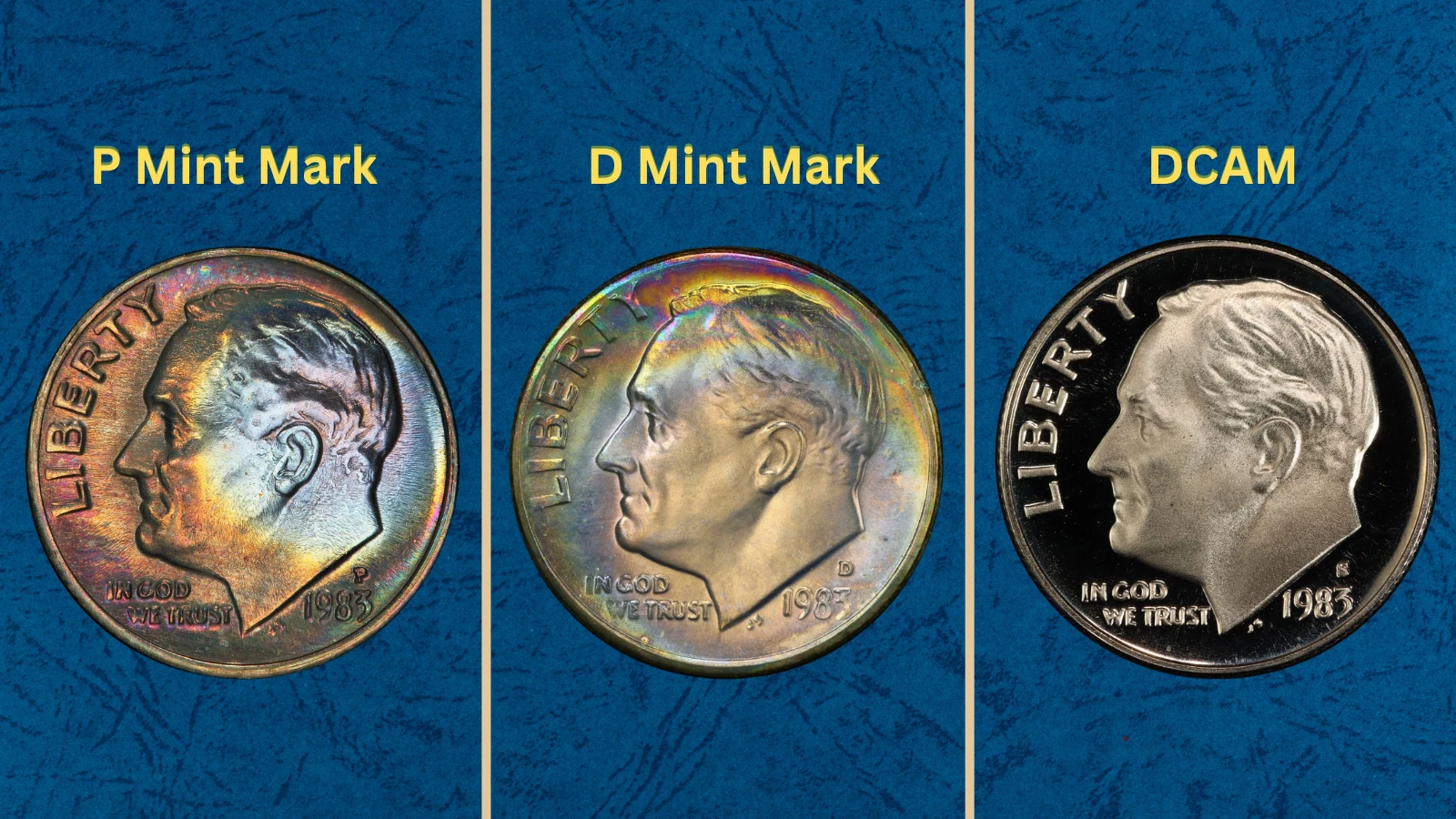
The mint mark on a 1983 Roosevelt dime appears on the obverse (front) side, directly above the date to the right of Roosevelt's neck truncation. Philadelphia coins show a "P", Denver coins show a "D", and San Francisco proof coins bear an "S". 1983 was among the early years that Philadelphia added the "P" mint mark to dimes, a practice that began in 1980.
The 1983-D RPM is a recognized die variety cataloged as FS-501 in the Fivaz-Stanton Cherrypickers' Guide and CONECA RPM-001. Known as a "D/D North," it shows a secondary "D" impression shifted directly upward from the primary mint mark. The doubling is visible at 10× magnification on the upper curve of the "D". This error occurred during die preparation when the mint mark punch was repositioned and struck a second time slightly off-register.
Standard 1983 business-strike dimes are not rare at all — over 1.37 billion were produced between Philadelphia and Denver. However, specific conditions and varieties are genuinely scarce. The 1983-P with Full Bands in MS-68 is known from fewer than 15 examples. The No S Proof, while not as legendary as the 1968 or 1970 No S, still numbers only a few hundred across all grades, making certified examples in high grades quite desirable.
Start by checking the mint mark — look for an "S" mark on what should be a proof coin; if it's absent, you may have a No S Proof. For business strikes, check the torch bands on the reverse under 10× magnification: fully separated horizontal lines indicate a possible Full Bands specimen worth a significant premium. For the 1983-D RPM, look for a faint secondary "D" above the primary mint mark. Any suspected rarity should be submitted to PCGS or NGC for authentication.
A standard 1983-S proof dime with Deep Cameo finish in PR-69 DCAM typically sells for $6–$15. Higher grades such as PR-70 DCAM can command $20–$50 or more depending on the registry population. These were struck in San Francisco exclusively for collector proof sets with a mintage of 3,279,126. Be careful not to confuse the standard 1983-S Proof with the far rarer No S Proof — the mint mark location is the key difference.
For business strikes, meaningful premiums begin at MS-67 ($75–$105) and increase sharply at MS-68 (around $480 for standard; $2,000+ for Full Bands). For the No S Proof, PR-67 DCAM sells for roughly $535–$735, PR-68 for around $575–$700, and PR-70 DCAM for $3,000–$10,560. Any grade below MS-65 on a business strike and below PR-65 on a standard proof is essentially worth face value or the modest proof set premium.
Absolutely not. Cleaning a coin — even with a gentle cloth or mild soap — damages the microscopic surface texture that graders use to assess luster, strike, and eye appeal. Cleaned coins receive a "details" designation from PCGS and NGC that significantly reduces value compared to original, uncleaned examples. If you believe you have a valuable 1983 dime, place it in a soft flip or holder and submit it to a professional grading service without touching the surfaces.
Use the free calculator above — takes less than 30 seconds and requires no signup.
Check My Coin Now →